When I first received some roving from local alpaca farm Flying Dutchman Alpacas, I wet felted a few “sheets” with the intention of making something useful. I love the texture and thickness of the hand felted material. I decided to make a zippered pouch for my new iPhone 6 Plus (that is so enormous it does not fit well in the open phone pocket I had made in my leather hobo bag for my previous iPhone.) I used a vintage cotton material for the lining and handstitched the zippered opening using a contrasting pink cotton thread.
Felting
Succulents for a tiny felt pot…
I created this tiny wool wet felted pot a long time ago. A couple days ago, I decided to complete it with some succulent pups cut from an Aeonium suffering a slow death in my front yard. The inside of the felt pot is painted with a bright yellow rubber coating that you can find at hardware stores for dipping tools, so it is waterproof. Wool felt is dirt and water resistant by itself, but I wanted to make sure the little pot didn’t decompose from constant contact with the moist potting soil. In restrospect, I prefer to keep the wool raw and natural rather than add the rubber coating. But of course I would not know that if I didn’t experiment in the first place.
Wet felting with Pre-K…
I worked with my daughter’s PreK class on a wet felted project for the upcoming school auction. We are creating a felted wall hanging. Each child made a “pebble” using natural alpaca roving decorated with wool yarn and scrap silk pieces. The background was a collaboration using a darker blend of alpaca roving with the same yarn and silk pieces placed in a random linear pattern. The background is as beautiful as each of the pebbles. Most of the pebbles are hand stitched onto the background with a wool/bamboo blend yarn. Three pebbles are suspended from the bottom of the wall hanging by needle felting pieces of colorful wool yarn onto the background and the pebbles.
Wet felting experiments…
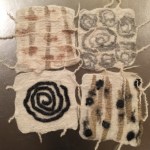
My girls and I are playing with wet felting. In these first experiments we used scraps of tulle, yarn, and beads to add color and texture to the roving. Most of the donate roving was a natural cream color, but one bag was filled with pastel pink, blue and purple. My daughters were ecstatic. The process of wet felting is relatively easy but requires letting go of perfection because wetting and rolling and shrinking makes for some surprising outcomes – at least for us amateurs. I’ll be bringing roving into Stella’s Pre-K class to make some wet felted “squares” with the kids. I’m excited to see what they make!
Natural branch chandelier…
Every Christmas, I alter our holiday decor a bit. This year I created a “chandelier” by suspending a juniper branch over our dining table and decorating it with handmade felted balls, Froebel stars, and crystal ornaments. The benefit of using a natural object for decor is that I can return it to nature when I am finished with it. And if I am lucky, this particular branch can be “found” again next holiday season.