
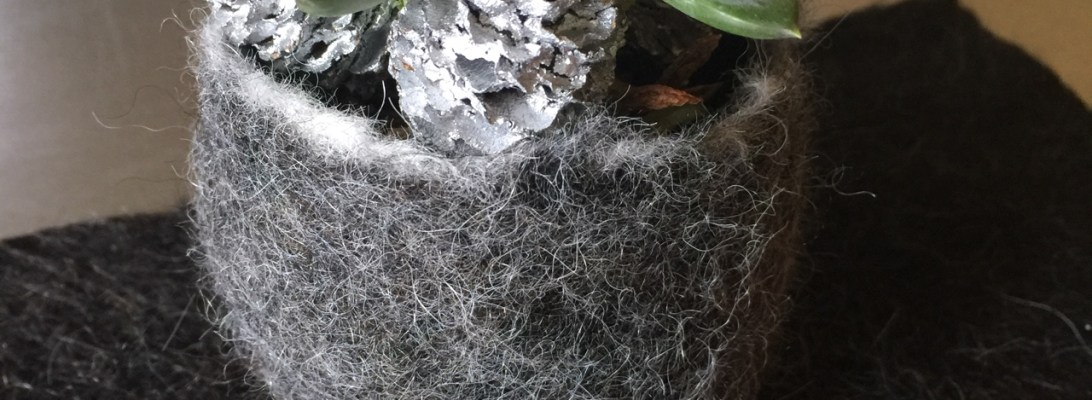
Wet felting surprises; using inclusions…

It is unusual for me to make anything more than once. New inspiration combined with an insatiable desire to experiment with new materials and techniques means I often make one and am done. But these felted vessels have held my interest. They are challenging yet can be made in a few hours. The process is familiar but little variations create interesting surprises. And of course, I just love wet felting. For this piece, I used black alpaca roving for the mat, but included a couple layers of white roving to cover the inclusion (a large Easter egg) before covering the whole piece again with more black roving. During the felting process, the white roving started to blend with the black making the vessel a dark gray. Once the inclusion was removed, the white was exposed on the inside of the vessel, creating a nice contrast with the black mat.

What I love about wet felting…

What I love about felting is the process – which is both demanding and forgiving; repetitive (meditative) and very physical (yes, muscle.) I can be precise or loose and still create something interesting. Mistakes can be opportunities.

I received some natural alpaca roving from Benvenuti Farm and decided to make another mat with integral vase or bowl. I love this minimal, modern design and need to come up with a more fitting name than “mat vase.”

This can be made in about 2 hours depending on the size and the inclusion. I first roughly needle felted four small mats which I then joined into a larger square. Then I placed an inclusion (a large Easter egg) on the square and covered it with cream roving and then with the tan roving to create a reveal of color on the inside when the egg is removed after felting. The whole piece is carefully wet felted so the inclusion does not shift around and so the thickness of felt remains consistent. When it feels complete, I cut out the egg and then wet felt the final piece one more time to make sure the interior of the vase is also tight and smooth. I let it sit overnight to dry and then I trim three sides and leave the fourth raw. The vase is the perfect size for a small potted succulent, an air plant, or some dried herbs or twigs.