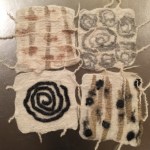
This set of handmade trivets was wet felted from a blend of natural merino and alpaca wool roving. 1/8” thick mats were cut into 10” and 8” squares. The remnant cut edges were then needle felted onto the squares to create a minimal vertical appliqué. Aside from the functional (and obvious) use as a trivet, I can imagine a whole wall covered in a grid of these minimalist felted squares. Like warm, textural wallpaper. Or more simply, they could be applied to a square piece of homosote and used as a pin-up board. I could also sew them into a quilt or create six quilted panels that are then sewn into a modern cube pouf. Lots of ideas and probably not enough time or focus for me to realize all of them.
wet felting
My first experiment in wet felting inclusions…
This is a one-piece bowl and mat centerpiece. I experimented with wet-felting an inclusion into a flat square layout of alpaca wool roving. I wrapped a plastic egg in dark gray roving and then placed it on my layout of cream roving, then covered everything with a few more layers of cream. After the felting process was complete, I carefully cut a hole and extracted the plastic egg. The result is a bowl with a dark interior that is integrated into a cream mat. Three edges are trimmed and the fourth is left raw like the top of the bowl. I absolutely love this piece. Yes, I will be making more.
Minimal, Modern, Matryoshka
I love nesting dolls. I have several versions of them as toys, decoration, and even measuring cups. So in my experiments with felting, I decided to try to create a version of nesting dolls. I used a set of plastic ones as a form. Many attempts failed as I found it hard to keep the thickness of the wool roving consistent in the wet felting process. Needle felting a hollow shape proved challenging too. But I persisted and was able to create this set of four dolls using a combination of wet felting and needle felting. I need to add some sort of reinforcement or fabric stiffener so the top and bottom actually securely connect and close. But I am a bit burned out by the struggle to get to this point, and I am a bit afraid to screw them up. Sometimes my experiments develop into a finished product, but often they are left unfinished and placed on a high shelf or tucked away in a box marking one more moment along my creative journey.
Succulents for a tiny felt pot…
I created this tiny wool wet felted pot a long time ago. A couple days ago, I decided to complete it with some succulent pups cut from an Aeonium suffering a slow death in my front yard. The inside of the felt pot is painted with a bright yellow rubber coating that you can find at hardware stores for dipping tools, so it is waterproof. Wool felt is dirt and water resistant by itself, but I wanted to make sure the little pot didn’t decompose from constant contact with the moist potting soil. In restrospect, I prefer to keep the wool raw and natural rather than add the rubber coating. But of course I would not know that if I didn’t experiment in the first place.
Wet felting with Pre-K…
I worked with my daughter’s PreK class on a wet felted project for the upcoming school auction. We are creating a felted wall hanging. Each child made a “pebble” using natural alpaca roving decorated with wool yarn and scrap silk pieces. The background was a collaboration using a darker blend of alpaca roving with the same yarn and silk pieces placed in a random linear pattern. The background is as beautiful as each of the pebbles. Most of the pebbles are hand stitched onto the background with a wool/bamboo blend yarn. Three pebbles are suspended from the bottom of the wall hanging by needle felting pieces of colorful wool yarn onto the background and the pebbles.
Wet felting experiments…
My girls and I are playing with wet felting. In these first experiments we used scraps of tulle, yarn, and beads to add color and texture to the roving. Most of the donate roving was a natural cream color, but one bag was filled with pastel pink, blue and purple. My daughters were ecstatic. The process of wet felting is relatively easy but requires letting go of perfection because wetting and rolling and shrinking makes for some surprising outcomes – at least for us amateurs. I’ll be bringing roving into Stella’s Pre-K class to make some wet felted “squares” with the kids. I’m excited to see what they make!